

In lifting projects, technical clarity often determines project speed, design accuracy, and procurement confidence long before equipment reaches site.
For engineers, riggers, and LOLER technical authorities, early access to accurate product data can reduce delays, improve planning, and support better technical decisions.
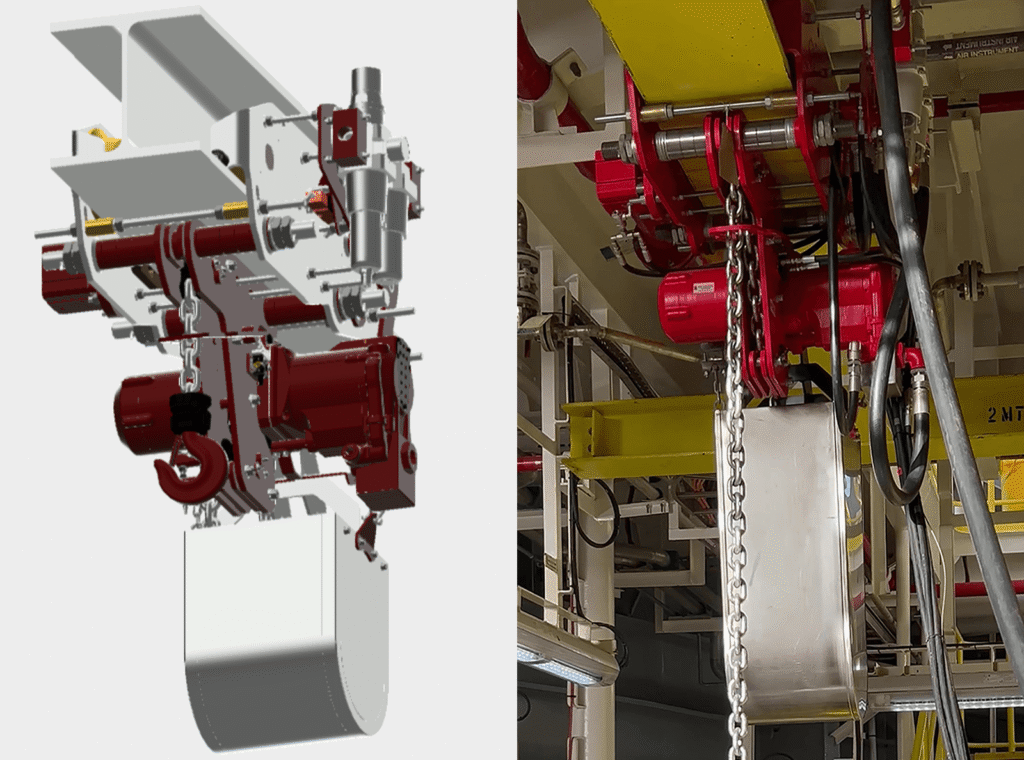
STEP files for hoists help make that possible.
By providing accurate 3D CAD product models, STEP files support project teams from concept design through lift planning, technical review, procurement, and deployment.
What STEP Files for Hoists Provide
A STEP file (Standard for the Exchange of Product Data) is a universal 3D CAD format used across major engineering platforms. Unlike basic spec sheets or dimensional drawings, STEP files provide detailed product geometry that can be imported directly into project layouts and technical design software.
This allows users to assess:
- Accurate dimensions
- Product geometry
- Spatial compatibility
- Headroom requirements
- Structural integration
- Integration within wider systems
For lifting professionals, this means better technical visibility before purchase, hire, or mobilisation.
How STEP Files Support Project Delivery
For engineers, riggers, and LOLER technical authorities, technical accuracy can shape project success long before lifting equipment reaches site.
STEP files for hoists provide accurate 3D CAD product data that supports project delivery from concept design through lift planning, technical review, procurement, and deployment.
Whether integrating lifting equipment into bespoke systems, developing lift plans, or preparing RFQs, accessible hoist CAD models can improve:
- Design integration within restricted environments
- Headroom, clearance, and spatial validation
- Lift planning and technical review accuracy
- Product suitability for specific lifting applications
- RFQ efficiency and technical communication
- Procurement confidence before hire or purchase
- Reduced redesign, specification errors, and approval delays
By improving technical clarity earlier, STEP files help align engineering, compliance, procurement, and operational teams more effectively.
Supporting Engineers, Riggers & LOLER Technical Authorities
For engineers, STEP files can support custom design integration by helping validate compatibility within bespoke lifting systems, crane structures, offshore frameworks, or restricted industrial spaces.
For riggers and LOLER technical authorities, STEP files can strengthen lift planning by improving equipment understanding during technical reviews, pre-mobilisation checks, and engineered lift assessments.
Under LOLER, lifting operations must be properly planned, supervised, and carried out safely. While STEP files do not replace formal lift plans, statutory inspections, or risk assessments, they can support technical oversight by improving product visibility during planning and specification.
Detailed lifting equipment CAD files can reduce RFQ delays by supporting faster technical clarification, better supplier communication, and more confident product validation before hire or purchase.
By bridging design, compliance, and operational delivery, STEP files help project teams move from technical review to real-world execution with greater efficiency.
Supporting Real-World Project Delivery
The value of STEP files extends beyond design software. They support practical project execution across demanding sectors.
Construction

In bridge deconstruction and structural dismantling projects, accurate hoist data can improve planning precision and equipment suitability before mobilisation.
Offshore & FPSO

In offshore environments, custom lifting solutions often require precise integration within restricted operational spaces.
For FPSO operations, STEP files can support early-stage validation by helping teams assess fit, clearance, and compatibility before deployment.
Across both sectors, accessible pneumatic hoist CAD downloads can help reduce project friction from planning through execution.
STEP Files Available Across Key Hoist Categories
To support project teams across multiple lifting applications, STEP files are available for:
This gives engineers, riggers, and LOLER professionals direct access to the technical resources needed for more efficient project planning.
Improve Project Planning with STEP Files for Hoists
STEP files for hoists do more than provide product visuals. They support stronger engineering decisions, improve lift planning, reduce RFQ delays, and increase procurement confidence.
For construction, offshore, industrial, and bespoke lifting projects, accurate 3D CAD hoist models can help reduce technical uncertainty before lifting begins.
From custom design through to operational deployment, accessible STEP files can improve project efficiency, reduce avoidable delays, and support smarter lifting solutions.