

As an operator, your equipment must run smoothly to avoid loss in productivity.. Air hoists are incredibly reliable, but like any piece of machinery, they can occasionally run into issues. This guide is designed to help you quickly diagnose and fix the most common problems you might encounter, getting your hoist back to work with minimal downtime.
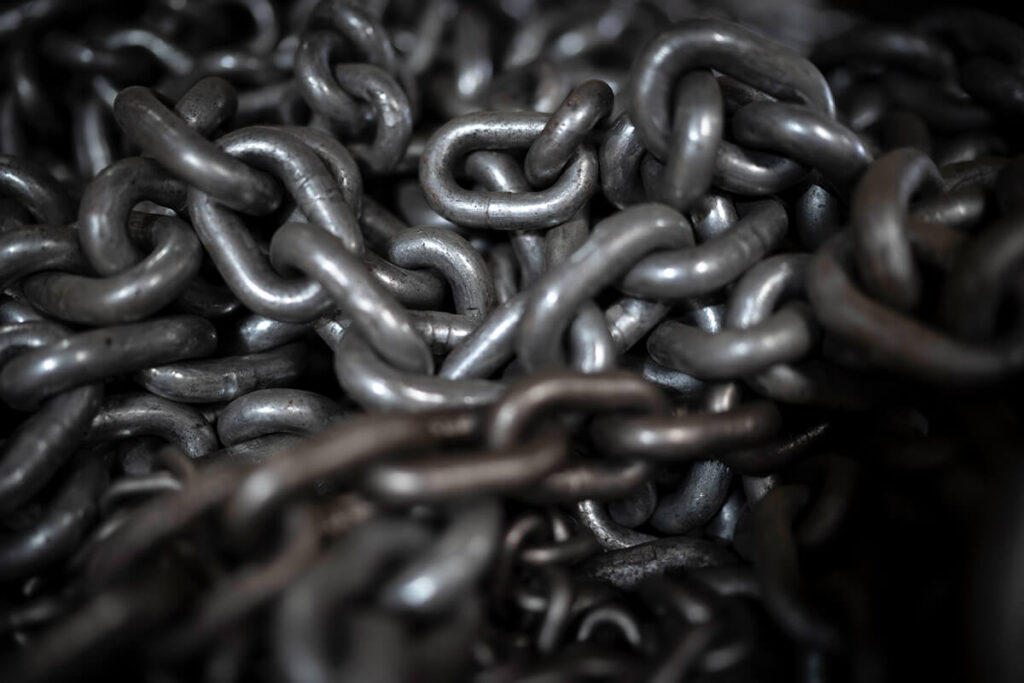
Common Causes and Solutions for Air Hoist Issues
1. Low Air Pressure or Flow
If your air hoist is lifting slowly, struggling to lift its rated load, or not lifting at all, the first thing to check is the air supply. Low air pressure or inadequate flow is a common fault. A pneumatic hoist requires a specific volume of air (measured in cubic feet per minute, or CFM) at a certain pressure (pounds per square inch, or PSI) to operate efficiently. If either of these is below the manufacturer’s specification, the hoist will underperform.
- Check the compressor: Ensure your air compressor is turned on, set to the correct pressure and the proper outlet is opened. A pressure gauge at the hoist’s inlet can confirm that the pressure is within the required range.
- Inspect air lines and hoses: Look for any kinks, leaks, or obstructions that might restrict airflow. A simple leak can dramatically reduce pressure. Listen for hissing sounds or use a soapy water solution to find leaks at connections. Ensure no debris is present within the air line before use.
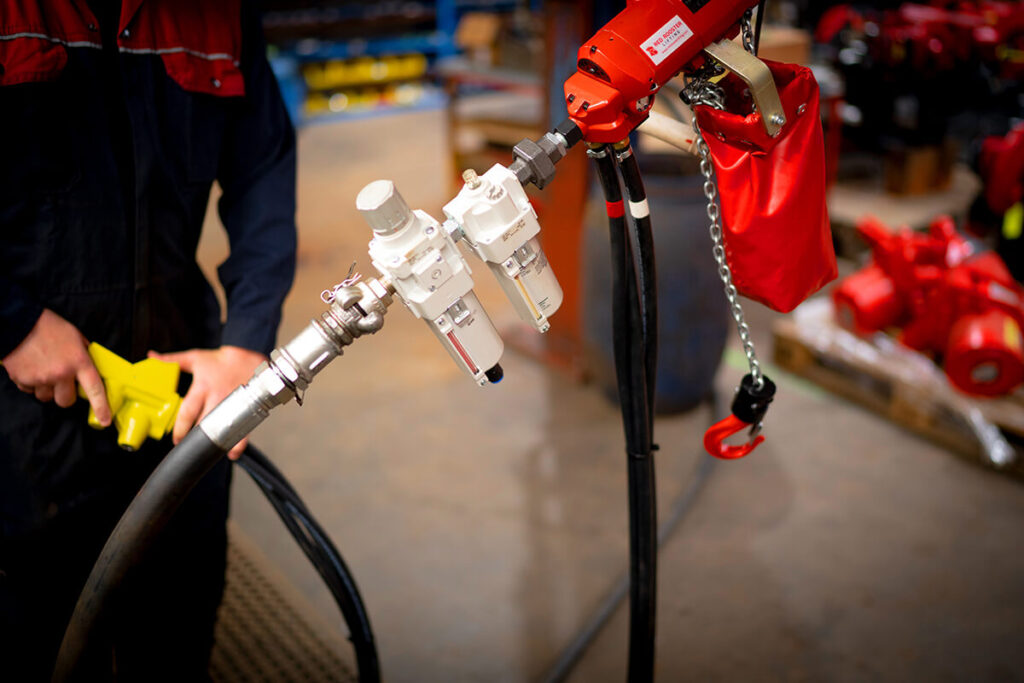
- Verify the lubricator: The lubricator bowl should be filled with the correct type of oil and correctly set to deliver a consistent mist to the hoist’s internal components. Without proper lubrication, the motor’s internal vanes can disintegrate, causing a drop in efficiency and power.
- Check for undersized components: Make sure your compressor and air lines are adequately sized for the hoist you’re using. An undersized system won’t provide enough airflow (CFM) or volume (l/sec), regardless of pressure, leading to sluggish operation.
- Check the table below to ensure the air flow requirement and minimum hose diameter are met.
| SWL (Tonne) | Model | Chain Falls | Weight (KG) | Air Consumption L/Sec | FLR Size | Minimum Hose Size (ID) | |
| 3M Hol | Extra P/M | ||||||
| 0.25 | TCR-250DPE | 1 | 7 | 0.35 | 13 | 0.5” | 0.5” |
| 0.5 | TCR-500 | 1 | 31.1 | 0.8 | 25 | 0.5” | 0.5” |
| 0.5 | TCS-500 | 1 | 19 | 0.8 | 28 | 0.5” | 0.5” |
| 1.0 | TCR-1000/2 | 2 | 35.2 | 1.6 | 25 | 0.5” | 0.5” |
| 1.0 | TCR-1000 | 1 | 34 | 1.1 | 25 | 0.5” | 0.5” |
| 2.0 | TCR-2000/2 | 2 | 39.7 | 2.2 | 25 | 0.5” | 0.5” |
| 3.0 | TMH-3000 | 1 | 99 | 3.8 | 56 | 1” | 1” |
| 3.0 | TCR-3000 | 1 | 69 | 2.7 | 33 | 0.75” | 0.75” |
| 6.0 | TMH-6000/2 | 2 | 124 | 7.8 | 56 | 1” | 1” |
| 6.0 | TCR-6000/2 | 2 | 91 | 5.4 | 33 | 0.75” | 0.75” |
| 9.0 | TMH-9000/3 | 3 | 200 | 11.4 | 56 | 1” | 1” |
| 9.0 | TCR-9000/3 | 3 | 150 | 8.1 | 33 | 0.75” | 0.75” |
| 10.0 | TMH-10T | 1 | 206 | 11.4 | 58 | 1” | 1” |
| 10.0 | TNC-10TWLPE | 2 | 210 | 11.4 | 90 | 1” | 1” |
| 12.0 | TMH-12000/4 | 4 | 210 | 15.2 | 56 | 1” | 1” |
| 12.0 | TCR-12000/4 | 4 | 170 | 10.8 | 33 | 0.75” | 0.75” |
| 15.0 | TMH-15000/5 | 5 | 253 | 19.0 | 56 | 1” | 1” |
| 15.0 | TMH-15T | 3 | 450 | 17.1 | 58 | 1” | 1” |
| 15.0 | TCR-15000/5 | 5 | 210 | 13.5 | 33 | 0.75” | 0.75” |
| 15.0 | TNC-15TW/3 | 3 | 320 | 17.1 | 90 | 1” | 1” |
| 20.0 | TMH-20T | 4 | 431.6 | 22.8 | 58 | 1” | 1” |
| 20.0 | TNC-20TW/4 | 4 | 470 | 22.2 | 90 | 1” | 1” |
| 25.0 | TMH-25T | 2 | 581 | 24.4 | 108 | 1.5” | 1.5” |
| 25.0 | TNC-25TWLPE | 2 | 490 | 21.8 | 90 | 1” | 1” |
| 30.0 | TMH-30T | 2 | 581 | 24.4 | 108 | 1.5” | 1.5” |
| 37.5 | TMH-37.5T | 3 | 1300 | 36.6 | 108 | 1.5” | 1.5” |
| 37.5 | TNC-37.5TW/3 | 3 | 870 | 32.7 | 90 | 1” | 1” |
| 45.0 | TMH-45T | 3 | 1300 | 36.6 | 108 | 1.5” | 1.5” |
| 50.0 | TMH-50T | 4 | 1315 | 48.8 | 108 | 1.5” | 1.5” |
| 50.0 | TNC-50TW/4 | 4 | 1110 | 43.6 | 90 | 1” | 1” |
| 60.0 | TMH-60T | 4 | 1315 | 18.8 | 108 | 1.5” | 1.5” |
2. Control Valve Issues
If the hoist isn’t responding to the pendant controls, the issue might lie with the control valve or the pendant itself. The control valve directs the flow of air to the motor, dictating the hoist’s movement.
- Damaged Pendant Hose: Check the pendant control hose for cuts, kinks, or abrasions. Damage can cause intermittent operation or total failure. Replace the hose immediately if any damage is found to ensure safety and proper function.
- Foreign Material: Dirt or debris can block the control valve or piping, leading to poor performance. To fix this, carefully disconnect the control lines and blow air through them to clear any blockages.
- Rust on Valve Parts: Rust can cause a valve to become sluggish or unresponsive. Inspect the valve for corrosion and replace any rusted parts. Proper lubrication helps prevent rust.
- Limit Spool Stuck by Rust: A rusted limit spool can cause the hoist to stop unexpectedly or fail to operate. If the spool is seized, it should be replaced along with its bush. Regular lubrication can prevent this.
- Damaged O-Ring: A damaged O-ring can cause air leaks, reducing performance. Replace any damaged O-rings and ensure they are properly seated during assembly to maintain a tight seal.
3. Trolley Problems
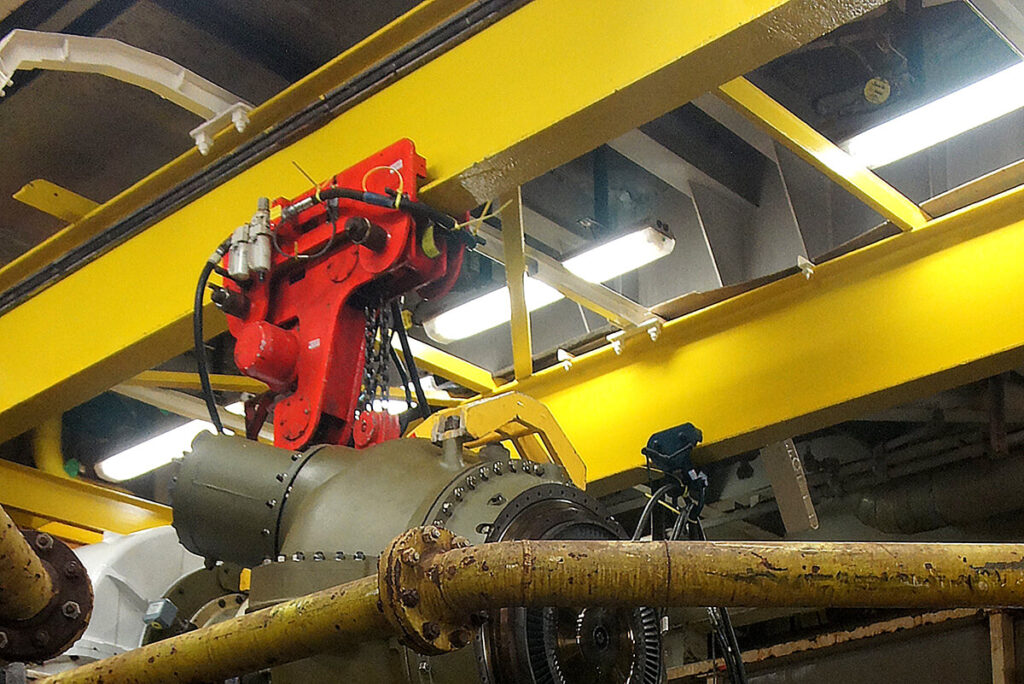
A hoist trolley that sticks, moves erratically, or is noisy can be a safety hazard and a sign of a larger issue. The trolley allows the hoist to move horizontally along the beam.
- Misalignment: The trolley wheels may not be aligned correctly with the beam flanges. This can cause binding and uneven wear on the wheels. Adjust the trolley to ensure the wheels make proper contact with the beam.
- Worn or dirty wheels: Inspect the trolley wheels for excessive wear, flat spots, or chipping. Dirt, debris, or rust on the wheels or the beam flange can also cause sticking. Clean the beam and wheels regularly.
4. Load Chain Problems
The load chain is crucial for lifting, and any issues here need immediate attention as they pose a significant safety risk. The chain should always be inspected before each use.
- Kinks or twists: Never use a hoist with a twisted or kinked load chain. This can weaken the chain and cause it to break under load. Lower the load and carefully untwist the chain before continuing.
- Wear and tear: Inspect the chain for stretched links, nicks, gouges, or other forms of damage. Pay close attention to the areas where the chain links rub against each other. A worn chain can snap under load, so it must be replaced immediately if any damage is found.
- Incorrect lubrication: Some hoist chains require lubrication to reduce friction and wear. Refer to your hoist’s manual for specific lubrication requirements.
5. Operator and Usage Errors
Sometimes, the “problem” isn’t with the hoist itself, but with how it’s being used. Lack of proper training can lead to issues that mimic mechanical failures. Ensure all operators are fully trained on proper hoist operation, capacity limits, and safety protocols.
Air Supply and Lubrication
Your hoist’s performance is directly tied to the quality of its air supply. An air preparation unit (FLR unit), which includes a filter, lubricator, and regulator, is essential for maintaining a clean and consistent air supply.
- Lubricator Bowl: A lubricator bowl that’s empty or incorrectly set won’t provide the necessary lubrication for the air motor. This leads to premature wear of internal parts, like vanes, and a drop in performance.
- Inadequate Air Supply: Check your compressor’s output and the size of your air lines. If they’re too small, they won’t provide the volume (l/sec) required by the hoist, resulting in slow or weak operation. A hoist rated for 90 l/sec, for example, will not work properly on a line that can only supply 50 l/sec..
Exhaust Port Enquiries
Customers often ask about the absence of a silencer on the main emergency stop exhaust port. This is a deliberate safety feature. When the emergency stop is pressed, the air must be vented as quickly as possible to stop the hoist’s motor. A silencer would restrict this rapid exhaust, delaying the emergency stop function. The noise is a consequence of a faster, safer shutdown.
Pendant Hose Identification
To make the operation clearer, we use colour-coded pendant hoses. This helps operators quickly identify which hose controls which function, especially in multi-function pendants. While specific colours can vary by model, here’s a general guide to help you identify what each colour represents:
- Red: This is your live feed, which delivers air from the hoist to the pendant.
- Green: Is the return line from the pendant to the emergency stop..
- Blue: Controls the right movement.
- Yellow: Controls the trolley left movement.
- White: Controls the hoist up movement.
- Black: Controls the hoist down movement.
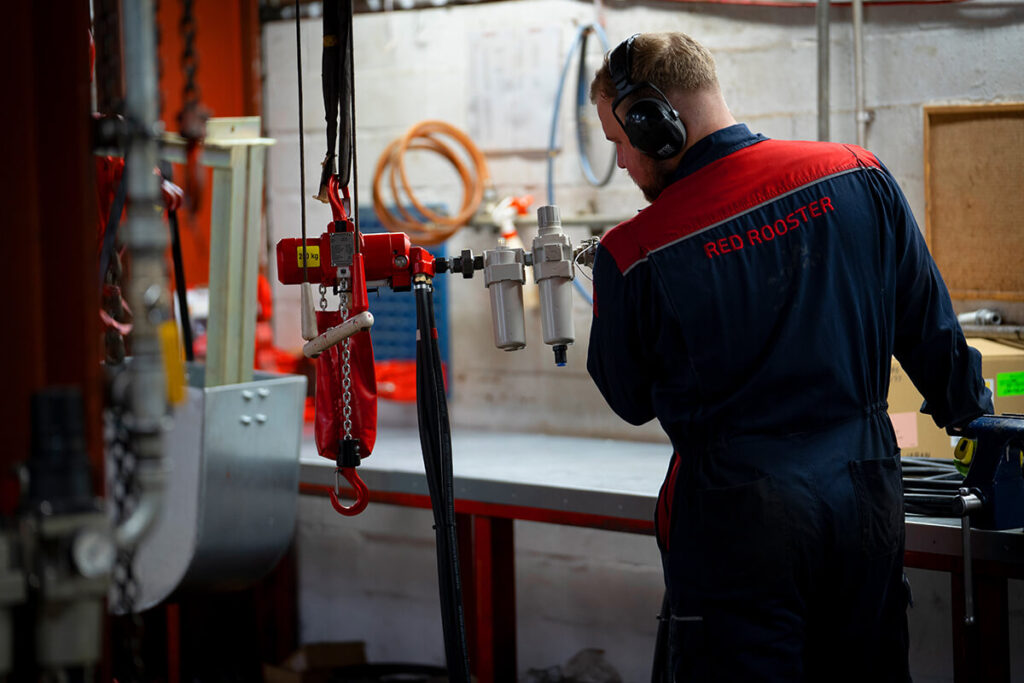
Ensure your Air Hoists are operating efficiently and safely today
By taking a few moments to understand these common issues and their solutions, you can keep your air hoist in top condition. Regular maintenance and prompt troubleshooting not only save you time and money but also ensure a safer working environment.
Looking for parts, service, or a brand new hoist? Contact the team at Red Rooster Lifting today, and we’ll help you find the right solution for your lifting needs.