


Load cells are the silent workhorses of the lifting industry. Functioning as precision instruments, they are critical for both accurate weight measurement and operational safety, providing real-time data on the stress being placed on lifting apparatus.
However, these highly accurate devices are also delicate. They rely on micro-stresses within internal components (strain gauges) to function. This means that seemingly minor operational errors or environmental factors can lead to costly failures, compromising the integrity of your entire lifting task.
To maintain optimal performance and prevent unnecessary downtime, it is vital to understand the most common ways load cells can fail. Here, we introduce the three key failure modes and detail the practical steps you can take to eliminate them.
Common Failure 1: The Sudden Stop
The Cause: Dynamics, Momentum, and Misalignment
Shock overload occurs when a force, whether kinetic (moving) or static (stationary), is applied to the load cell instantaneously and exceeds its capacity, known as the static overload limit.
In lifting operations, loads are rarely perfectly static. They involve momentum, acceleration, and deceleration, all of which multiply the actual force experienced by the cell.
Common causes of shock overload include:
- Dropping or swinging loads, allowing kinetic energy to convert into a massive instantaneous force upon arrest.
- Sudden jerks from poorly started or stopped lifts.
- Poorly calculated lifts where the forces of acceleration and deceleration are ignored, leading to a temporary force that exceeds the nominal weight.
Practical Prevention
Preventing shock overload starts with equipment selection and is secured through careful operation.
Selection: Always use load cells with an adequate capacity that accounts for potential dynamic multipliers. It is often wise to choose a capacity significantly higher than the expected Static Working Load Limit (WLL) to provide a safety buffer against unexpected shocks.
Operation: Use gradual speed control on hoists and cranes to eliminate jerking motions during the start and end of lifting and lowering phases. Air hoists are often considered ideal for precision lifting due to their incredibly fine control and smooth acceleration/deceleration capabilities.
Common Failure 2: Eliminating Side Loading
The Cause: Misalignment and Non-Vertical Forces
Load cells are engineered to measure compression or tension along a single, primary axis of measurement. Side Loading is defined as any force applied perpendicular to this axis. This force distorts the internal strain gauge structure in a way it wasn’t designed to handle, leading to inaccurate readings, premature fatigue, and eventual failure.
Common causes of side loading include:
- Incorrect installation leading to non-plumb line rigging.
- External environmental factors, like strong winds or cable drag, push the load laterally.
- Using improper shackles, hooks, or rigging components that bind or prevent free rotation under a load.
Practical Prevention
Side loading can be eliminated through careful setup and the right hardware.
Rigging: Utilise self-aligning hardware, such as swivel hooks or proper load shackles. These are designed to naturally correct minor misalignment issues, making sure the force vector remains perfectly axial.
Setup: Before any lift, visually confirm that the load cell is hanging perfectly vertically. This is easily overlooked, particularly when installing a cell underneath a hoist or crane where the mounting point might not be perfectly aligned with the lifting point below.
Monitoring: Where practical, use visual checks or electronic alignment aids to confirm proper load cell orientation immediately before initiating the lift. If the cell is not in line, stop and adjust the rigging.
Common Failure 3: Addressing Zero Error
The Cause: Fatigue, Temperature, and Environmental Stress
Zero Error is a failure mode where the load measuring equipment displays a non-zero reading when no load is applied. This indicates that the internal strain gauges have been permanently stressed, compromising the device’s fundamental calibration and accuracy.
Common causes of zero error include:
- Material fatigue, which may occur over long periods or be accelerated by repeated, mild overloads that cumulatively stress the gauge structure.
- Temperature fluctuations, which cause thermal expansion and contraction of the cell’s body, physically alter the strain gauges and shift the zero point.
- Moisture or dust ingress into the strain gauge area can interfere with the electronic components and cause unstable or false readings.
Practical Prevention: Protect, Calibrate, and Recertify
Zero error is prevented through robust protection and stringent maintenance schedules.
Protection: Ensure your load cell’s Ingress Protection (IP) rating is suitable for its environment. For example, an IP68 rating is necessary for outdoor use or washdown areas, protecting against water and dust intrusion.
Maintenance: Implement a programme of regular professional calibration and recertification. This is not only a best practice for accuracy but is often a legal requirement (e.g., as mandated by LOLER in the UK). Calibration resets the zero balance and verifies the cell’s linearity and accuracy across its full range.
Storage: When a load cell is not in use, make sure to store it in a clean, dry area. This minimises temperature shock and moisture exposure, which can induce zero shift over time.
Making Informed Choices with Your Lifting Partner
By actively preventing these issues, you achieve three outcomes:
- you save money by eliminating costly repairs and downtime
- you enhance safety by ensuring accurate load monitoring
- you maintain accuracy for precise operations
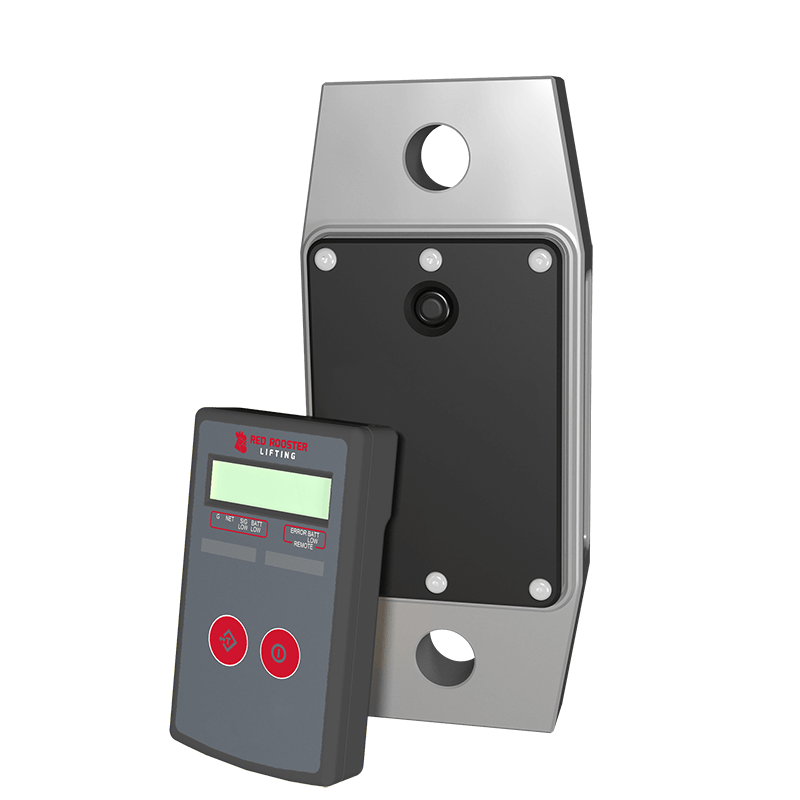
Choosing the right equipment and committing to operational protocols is non-negotiable. Whether through supplying reliable, well-maintained equipment for hire or advising on the right robust models for purchase, Red Rooster Lifting provides the technical support and certified, high-IP-rated models you need to lift safely and accurately, every time.
Contact us today to find out more.
FAQs
Every 12 months is the standard recommendation for professional recalibration and recertification.
Choose a load cell with a rated capacity (WLL) that is significantly higher than the maximum expected static load to account for dynamic forces, sudden stops, and accelerations.
Yes. Using self-aligning components like clevis assemblies or load shackles is highly recommended as they ensure the load cell remains aligned with the force vector, even with minor movement or setup errors.
Ensure the load cell has an appropriate Ingress Protection (IP) rating, such as IP67 or IP68, and store it in a temperature-stable, dry environment when not in use.
Yes. When you hire from a reputable company like Red Rooster Lifting, the equipment is supplied fully certified and calibrated, eliminating your immediate maintenance and certification responsibility.