

Decommissioning older industrial facilities—including nuclear power plants, chemical manufacturing sites, and complex offshore platforms—is a major, growing global challenge. It is an engineering task defined by extreme complexity, heightened safety risks, and intense regulatory scrutiny.
Unlike routine maintenance or greenfield construction, decommissioning involves lifting components that are often contaminated, difficult to access, or require precise handling over extreme distances. Success in this environment hinges not on standard equipment but on specialised lifting hoists designed for capacity, protective durability, and precision.
The Unique Demands of Decommissioning Lifts
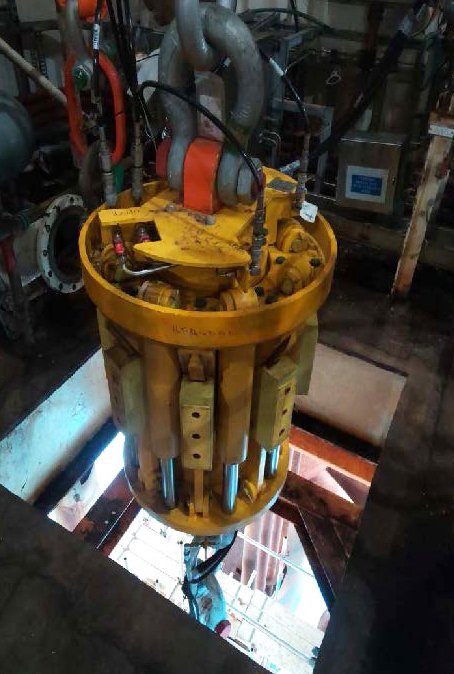
Lifting in a dismantling scenario is very different from a typical industrial lift. The constraints often dictate the engineering solution, starting with the load itself.
The Nature of the Load:
The hoists must handle components that carry inherent risk, where stability is a requirement:
- Radioactive components within nuclear facilities often involve highly activated reactor internals, irradiated piping, or spent fuel elements. These items require absolute zero-drift capability.
- Chemically or biologically contaminated vessels and associated plant equipment from processing or manufacturing sites. The components are often structurally compromised by years of use in harsh environments.
- Large, heavy, or awkwardly shaped machinery whose mass distribution is uneven or unknown. Lifting these loads requires load cells and control systems to monitor load in real-time.
The Environment:
Lifting operations frequently occur in challenging, restricted, or hazardous spaces that severely limit human access and intervention:
- Reactor cavities or deep spent fuel storage wells often require submersible components or hoists sealed against moisture and steam.
- Deep shafts or access tunnels with extremely confined spaces. This environment mandates specialised trolley systems with ultra-low headroom designs.
- High-altitude structural dismantling in industrial stacks or flare towers requires hoists that are capable of surviving intense weather exposure.
Handling Long Lifts and High Service Life
When dealing with deep cavities or towering structures, the hoists must perform reliably and precisely over different lifting ranges.
Deep Lifts and Precision Control
Applications such as removing equipment from deep storage wells or lifting components from the base of a tall stack demand lifting gear far beyond the reach of standard hoists.
- Hoists with exceptionally long lifting heights: Red Rooster Lifting supplies hoists engineered to manage chain spans often exceeding 100 meters, complete with custom chain storage systems.
- Maintaining Stability Over Distance: Precision is critical. This is achieved through sophisticated variable-speed pendant controls.
High Reliability and Low Maintenance:
A hoist failure mid-lift in a contaminated zone is not just a costly delay; it can compromise the entire project safety case and regulatory timeline.
- High Duty Cycles: The hoists must be rated for continuous, heavy-duty operation (e.g., FEM 3m or ISO M4 classification). We prioritise robust pneumatic systems known for their longevity and resilience.
Protective Casings and Decontamination
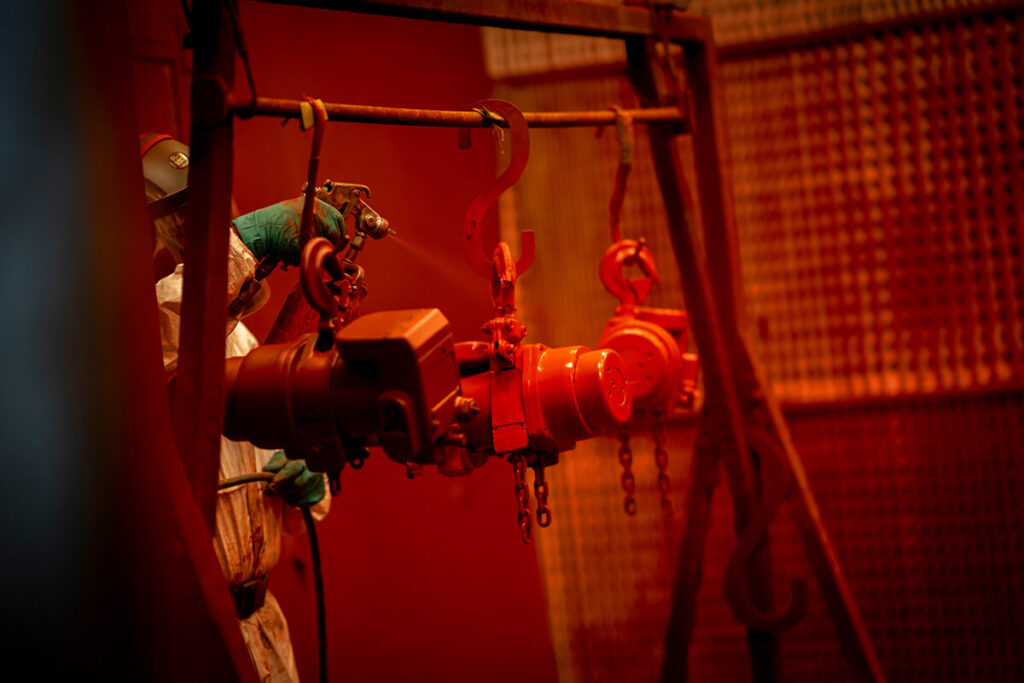
Working in radiological or chemical environments means the hoist itself will likely become contaminated. Its design must allow for safe, effective cleanup and, if necessary, disposal.
Materials and Finish: The Decon-Ready Design
Hoists must be built to withstand and resist harsh cleaning processes and prolonged exposure to corrosive agents:
- Corrosion Resistance: Extensive use of high-grade steel for external casings, zinc coating on load hooks, and other components that are most susceptible to chemical attack.
- Specialised Coatings: Application of a marine specification paint that is known to resist penetration by common decontamination solutions, ensuring that there is less chance of surface contamination.
Partnering for Safe Decommissioning
Effective decommissioning demands equipment that goes beyond standard industrial specifications. It requires hoists built for long-lift capability and robust protective casings.
At Red Rooster Lifting, we provide customised, certified lifting solutions engineered specifically for the harsh and hazardous requirements of large-scale dismantling and clean-up projects in the nuclear, oil and gas, and chemical sectors.
Contact us today to find out how we can help with your decommissioning project.
FAQs
Why can’t we use a standard industrial hoist for decommissioning tasks?
Standard hoists lack the essential features: they cannot achieve the deep lift ranges (often limited to 30m), are not built with decontamination-ready materials, and crucially, they lack the extreme precision and duty cycle rating required for long-term, non-interruptible use in highly regulated, inaccessible environments. The potential for catastrophic failure is simply too high.
What does “long lift capability” mean in a decommissioning context?
It refers to the capacity to lift or lower multi-ton loads through vertical distances typically exceeding 50 to 100 meters. This requires specialised engineering of the chain bucket to handle the vast amount of media, as well as integrated pendant control systems to maintain smooth, consistent speed and positioning accuracy over the entire extended range.
Are hoists from Red Rooster Lifting customisable for specific contamination threats?
Absolutely. Customization is our speciality. We can equip hoists with specific protective coatings, and install safety features to meet the precise regulatory and environmental challenges of any nuclear, chemical, or offshore decommissioning site.